Week 2
I. Goals
- Have decided to focus on the genetic algorithm for training (because
it's neat).
- Final program will consist of, at minimum:
- The neural network engine, responsible for simulating the networks.
It may be possible to use public domain class libraries to reduce
coding effort; one such package is available
here.
- The genetic algorithm, responsible for breeding networks,
determining which ones survive into the next generation, etc. There
is a fairly impressive C++ genetic algorithms library (freeware)
available here.
- A suite of functions to visualize individual neural networks.
- Routines to visualize the evolution of the networks.
- GUI code to hold everything together.
- This tool could be used (a) by professionals to help evolve neural
networks to solve specific problems, and (b) by students to get an
intuitive understanding of how neural networks and the genetic algorithm
work.
II. Possibilities
- Ability to load networks created by other programs (f.e. EasyNN,
QwikNet, etc.)
- Ability to "play God" by selecting which neural networks breed
together, modifying the edge weights or topology of existing networks,
etc.
- Ability to view the family tree of a neural network, and possibly
to animate the transitions between generations.
III. Scalability: The Problem
- In Neural Networks, Volume 8, Number 6, the article "Radial
Basis Function Network Configuration Using Genetic Algorithms"
(pp. 877-890) described a genetic algorithm used to solve a fluid
dynamics problem. The number of nodes was allowed to vary, and they
found that successful networks tended to have between 15 and 60 nodes.
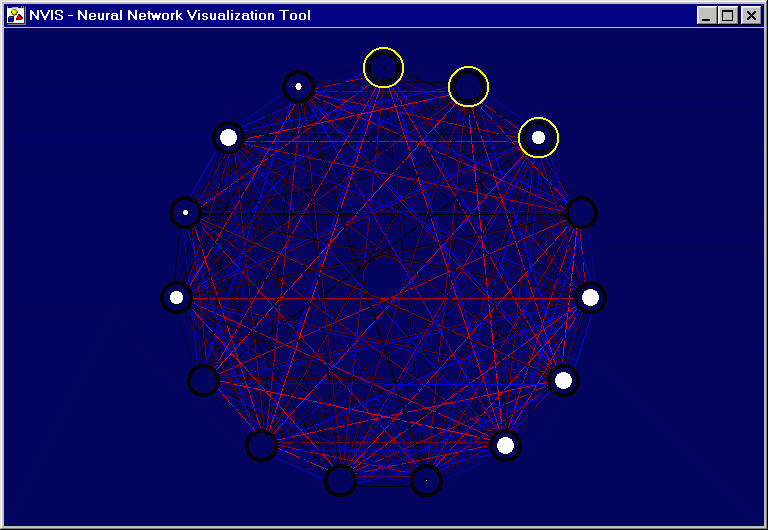
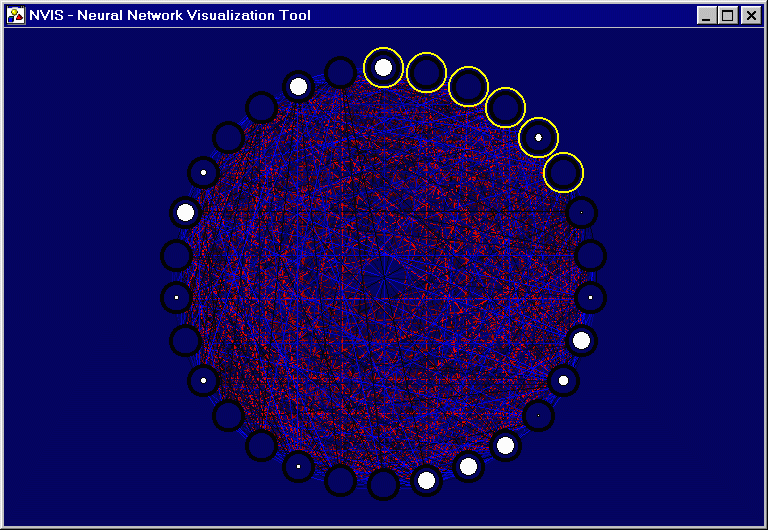
- The screen shots below illustrate the appearance of my prototype
interface with 15, 30, and 60 nodes.
15 nodes:
30 nodes:
60 nodes:
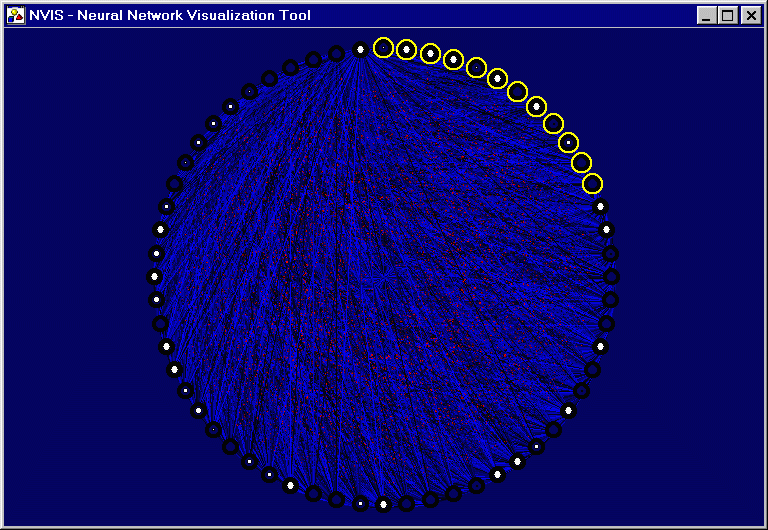
Clearly, the presentation of the edge weights becomes questionable
at 30 nodes, and absolutely incomprehensible at 60.
IV. Scalability: Possible Solutions
- The number of edges is (n-1)2 for a graph with
n nodes. This quadratic expansion will make it difficult for any
visualization system to represent the edge weights.
- The clutter in the pictures above could be reduced by using
line-drawing routines that add to, rather than overwrite, the pixels
underneath. It will also help when opacity is used instead of brightness.
- Presentation of edge weights could be reserved for detail view of
each node. In the normal view, you could just have some indication of
the total weight of the edges going into and out of each node, to make
it easy to hone in on the important nodes.
V. Research
- No good pictures in neural network journals (sigh).
- List of public domain neural networks tools available
here.
- I have found a very good paper entitled "Evolutionary Design of
Neural Architectures - A Preliminary Taxonomy and Guide to Literature"
which provides an overview of most of the issues involved. A PostScript
version is available
here. Among
the points I noted are:
- Evolution of network topology seems to be taken as a given; the edge
weights are sometimes evolved, sometimes determined by back propagation.
- The article states that "Despite much research activity in this area
. . . the design of artificial neural networks (ANNs) for specific
applications . . . is, to a large extent, a process of trial and error,
relying mostly on past experience with similar applications." This
seems to support the need for a visualization tool.
- Neural networks are not always fully connected, as I had
thought; in fact a connectivity matrix is one of the encoding schemes
for topology. This may alleviate, to some extent, the scaling problems
mentioned above.
The article has a 300+ entry guide to relevant papers, which should
greatly ease further research in this area.