Week 4
I. Graph Prototype
- Ported Prof. Rana's Evolution Strategies code to Borland C++.
- Added diversity metric discussed in last week's notes.
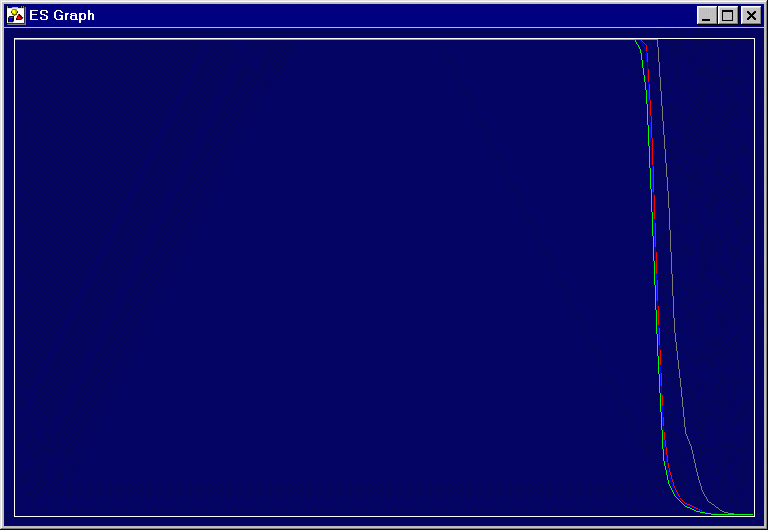
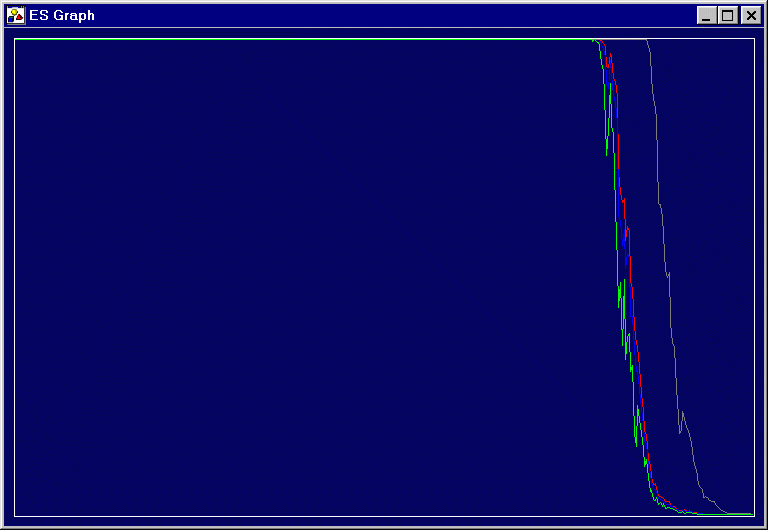
- Created primitive graphing tool for ES data. The following three
graphs show convergence for several different population sizes.
- The (mu,lambda) notation is used, where mu is
the number of parents, lambda the number of children, and the
best mu offspring are chosen as the next parent generation.
- The maximum (worst), minimum, and average fitness scores are
graphed in red, green, and blue, respectively. Diversity is graphed in
gray.
- The x-axis is the number of generations; the y-axis is
the fitness or diversity value. Values are mapped onto the y-axis
using a Sigmoid scale (the Sigmoid function maps all values from -inf to
+inf onto the range 0 to 1). Thus the horizontal lines at the top
of each graph are not "cutoffs"; the values are simply so large that
their Sigmoid function, when rounded to the nearest pixel, ends up at
the top.
ES: (10,100)
ES: (10,50)
ES: (5,100)
- Obviously it would be useful to have scale information and a legend;
I simply haven't gotten to this yet.
- The horizontal lines at the top of each graph are bad; I will have to
modify the Sigmoid function somehow to make the mapping even more
dramatic.
- It may also be useful to graph the first derivative of these
quantities.
- What may work for the scaling function is to have a logarithmic scale
(say 10-3 to 1024), with a special section at the
top (1024 to infinity) that is Sigmoid-mapped.