Week 8
I. Feedforward Network Visualization
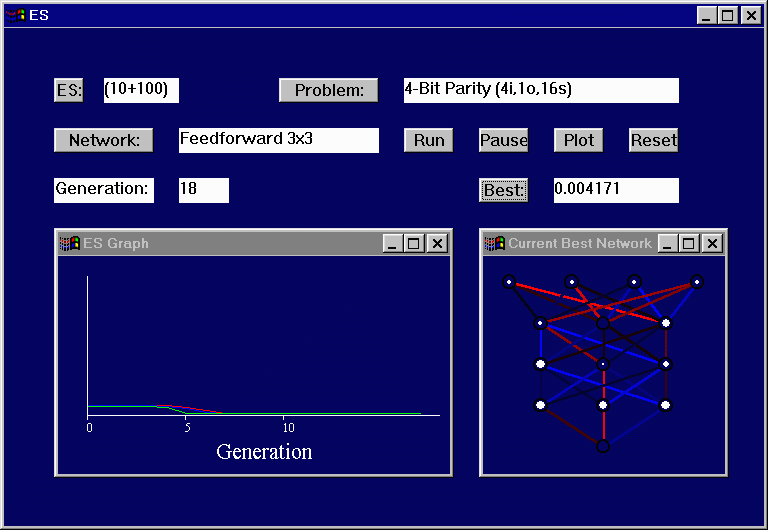
- I have implemented a window class for feedforward network visualization
based on my Hopfield visualization techniques.
- I now use red links to denote negative weights, and blue links to
denote positive weights. In my circular visualization, I had used link
color to indicate direction, with red lines representing links flowing
in the counter-clockwise direction, and blue lines for clockwise.
Clearly this
is unnecessary for feedforward networks, since the direction is always
down. But I think I will change the circular visualization as well,
using white-tipped lines as arrows. This avoids the clutter of actually
drawing an arrow, plus it allows me to use color consistently across
different types of network visualization.
- Here is a sample of the interface as it stands:
II. Experiments with Parity
- In testing out my visualization window class, I attemped to solve
the 4-bit parity problem using a network with one hidden layer and five
hidden nodes. The following network produced a near-zero fitness score
for this problem:
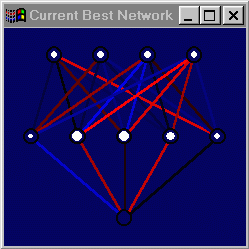
In looking at this network, it is clear that only three of the hidden
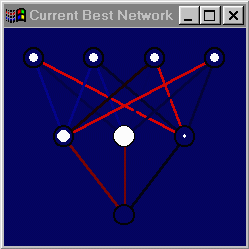
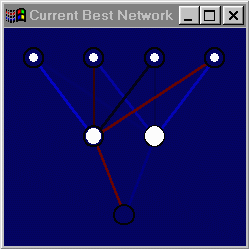
nodes are actually being used; i.e. two of the links to the output layer
are black, and therefore nearly zero. Observing this, I was able to
obtain faster convergence using 3 hidden nodes, then again using only
two: